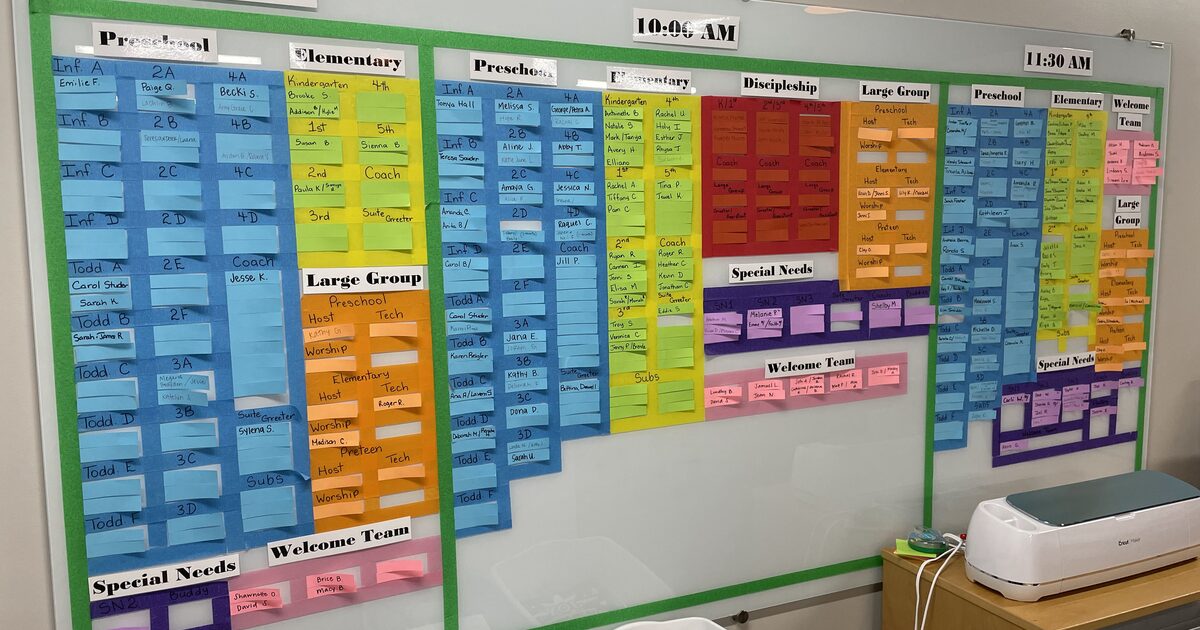
If you’ve started Googling church volunteer scheduling software, you’ve probably hit a wall of options that all promise the same thing: fewer gaps, fewer group texts, fewer Saturday-night scrambles. It’s a reasonable thing to want. But before you add another login to your stack, it’s worth asking a harder question — is scheduling actually your problem, or is it just where the problem shows up?
For most churches, the answer is the second one. The schedule isn’t broken. It’s the layer underneath it — whether volunteers feel known, informed, and equipped — that’s quietly failing, and a new scheduling tool won’t touch any of that.
Scheduling software solves a narrower problem than it looks like
Scheduling tools are genuinely good at what they do: open slots, claimed slots, swap requests, reminder texts. If your church is still running Sunday assignments through a shared spreadsheet or a string of group messages, a dedicated tool will absolutely clean that up.
Here’s the catch — most churches already have this. If you’re on Planning Center, Church Community Builder, Breeze, or almost any modern ChMS, scheduling is already built in. It’s tied to your attendance records, your check-in system, and your people data. Layering a second, separate scheduling tool on top of that doesn’t add a missing capability. It adds a second source of truth that someone now has to keep in sync with the first one — usually you, usually manually, usually on a Saturday.
So the real question isn’t “which scheduling software is best.” It’s “do I actually need a second one, or does my current system already do this — and is something else the thing that’s missing?”
What’s actually missing usually isn’t scheduling at all
Walk through a typical Sunday-morning breakdown and notice where it actually starts. It’s rarely “the slot wasn’t filled.” It’s things like:
- A volunteer said yes to a schedule, but nobody ever checked in on how they were doing — and three weeks later they quietly stopped responding.
- A new volunteer showed up on the schedule without ever getting trained, so they stood in the room unsure what to do.
- A last-minute change went out by text to half the team and got missed by the other half.
- The same five reliable people keep showing up on every schedule, because no one’s tracking who’s being asked and who isn’t.
None of these are scheduling failures. They’re burnout, communication, and training gaps that happen to surface on a Sunday. A better scheduling tool makes the slot-filling part smoother, but it has nothing to say about any of this — because that was never what it was built for.
It’s worth noticing, too, that these are the same gaps behind most volunteer retention problems. Churches rarely lose volunteers because a schedule glitched. They lose them slowly, over months, because no one noticed they’d stopped feeling connected to the team. A faster scheduling tool won’t show up anywhere in that story — but a better care system will, because it’s built to catch exactly that kind of quiet drift before it turns into a goodbye conversation.
The two layers every volunteer ministry actually needs
It helps to think of this as two separate layers, because trying to solve both with one tool is where most churches get stuck.
The schedule layer answers where and when. Who’s serving this Sunday, in which role, at which service. This is logistics — and it’s exactly what your ChMS is already good at. If yours isn’t, fixing the scheduling process itself is worth doing before you buy anything new.
The care layer answers who, and how are they doing. Does this volunteer feel equipped for the role they’re in? Have they heard from a leader lately, or just gotten logistics texts? Are they three Sundays away from quietly burning out, and would anyone notice before they did?
Most churches have invested entirely in the schedule layer, because it’s the loud, visible problem — gaps show up immediately, every week, in public. The care layer fails quietly instead. A volunteer doesn’t announce they feel disconnected; they just stop answering the next ask. By the time you notice, you’ve usually lost them.
A second scheduling tool can only ever strengthen the layer you’re already strong in. It can’t build the one you’re missing.
What to build instead of buying another scheduling app
If scheduling itself genuinely isn’t working, fix that first — a cleaner process, not necessarily new software, is often enough. Building the schedule by role instead of by name, setting a longer planning horizon, and keeping a short list of flexible fill-ins solves most of what people think they need a new tool for.
But if your schedule runs fine and the real pain is somewhere else — volunteers who feel like names on a list, new people who never get properly trained, a leader who has no idea who’s close to burning out — that’s a different problem, and it calls for a different kind of tool. One built specifically to communicate with your team without another group text thread, to get people trained in short, practical sessions instead of a one-time orientation, and to flag the volunteers who need a check-in before they disappear.
This is where Volunteer Circle fits. It isn’t another scheduling tool, and it was never meant to replace the one you already have. Keep building your rota in Planning Center, Breeze, or whatever your church runs on — that part’s working. Volunteer Circle is the layer around it: a directory that actually reflects your teams and ministries, care nudges that catch the volunteer who’s about to go quiet, short video training your team will actually finish, and messaging that doesn’t require a new group chat for every announcement.
A simple way to tell which problem you actually have
Before you spend another afternoon comparing scheduling software, ask these three questions:
- Is the schedule itself breaking — slots going unfilled, swaps falling through the cracks, confusion about who’s serving when? If yes, that’s a real scheduling problem, and it’s worth solving directly.
- Is the schedule fine, but the people on it feel disconnected, undertrained, or unseen? If yes, scheduling software won’t fix it — no matter how good the interface is.
- Do you already have scheduling built into your ChMS, and you’ve just never set it up well? This is the most common answer, and it means the fix is a better process, not a second subscription.
Most churches searching for scheduling software are actually living in question two or three. The slot-filling isn’t the thing keeping you up — it’s not knowing whether your volunteers feel cared for, or whether the new person you recruited last month ever got trained, or whether your most faithful server is three weeks from quietly stepping back.
That’s worth naming clearly before you buy anything, because it changes what you should be shopping for. You’re not missing a scheduling app. You’re missing the system that cares for, trains, and communicates with the people the schedule is built around — and that’s a different tool entirely.
If that’s the gap you’ve been feeling, join the Volunteer Circle beta. We’re bringing on a small group of churches to build the care layer around whatever you’re already scheduling with — no need to rip anything out to get started.
Bring it all into one place
Volunteer Circle helps church leaders communicate with, care for, and train their volunteers — without the spreadsheets.
Join for Free