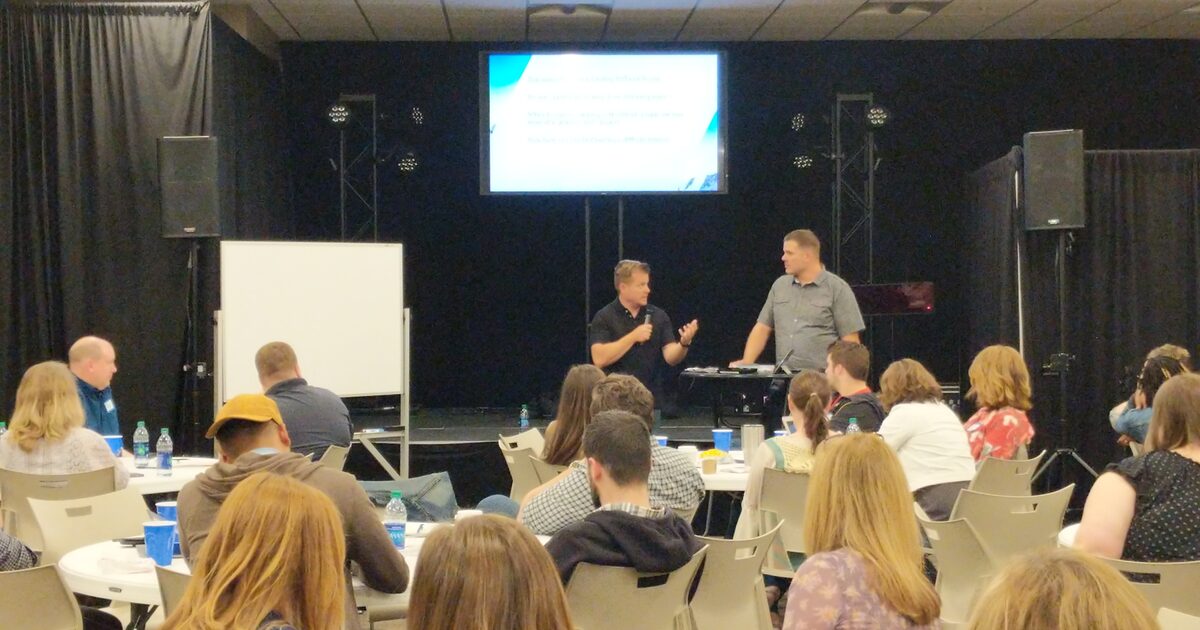
Handing someone a group of kids, students, or adults to lead each week is one of the higher-trust roles in your church — and one of the easiest to under-train. Training small group leaders well is different from training a greeter or a parking-lot volunteer, because the job itself is relational, not procedural. You can hand someone a checklist for running check-in. You can’t hand someone a checklist for “notice when a fifteen-year-old has gone quiet for three weeks.” That skill has to be built, modeled, and practiced — and most churches skip straight from “we need leaders” to “here’s your group” without ever building it.
This guide walks through what new small group leaders actually need before their first week, how to train them without turning it into a seminar nobody has time for, and how to know when someone’s genuinely ready to lead on their own.
Start with what the role actually requires
Before you train anyone, get specific about what a good small group leader does in your context, because the term covers a wide range of jobs. A preschool small group leader is managing attention spans and safety — the same ground children’s ministry volunteer training covers in depth. A middle schooler’s leader is managing silence and distraction. An adult group leader is facilitating discussion and remembering what’s going on in people’s lives between meetings. Small group leader role descriptions differ enough by age group that “train your leaders” isn’t really one task — it’s several, and treating it as one is how training ends up too vague to help anyone.
Write down the three or four things a leader in this specific role needs to do well: lead a discussion from a guide, keep a room safe and on track, notice and respond when someone’s struggling, follow up between sessions. That short list becomes your actual training curriculum. Everything else is optional.
Teach the relational skill, not just the content
Most small group curriculum comes with discussion questions already built in, so new leaders assume the job is “ask the questions on the page.” The real job is noticing who hasn’t spoken in ten minutes, redirecting a tangent without embarrassing anyone, and following up with the student whose one-word answer clearly meant more than one word. That’s the part curriculum can’t teach, and the part training usually skips.
Spend real training time on this, not just the content. Role-play a group that’s gone quiet. Talk through what to do when one person dominates every discussion. Give new leaders actual language for the follow-up text after a hard week — something as simple as “hey, thinking about what you shared tonight, you doing okay?” The content is replaceable. The relational skill is the actual job, and it’s the one most new leaders have never been shown how to do.
Use the observe, assist, lead progression
The fastest way to build real confidence in a new leader is the same progression behind training any church volunteer well: they watch an experienced leader run a session, they co-lead the next few with that leader right there, then they run it themselves with support nearby. Skipping straight to “here’s your group, good luck” is how you end up with leaders who either freeze the first time something goes sideways, or quietly decide after one hard week that this isn’t for them.
Pair every new small group leader with an experienced one for at least two or three sessions before they’re on their own. It costs you a few weeks of double-staffing a room. It saves you a leader who burns out or disappears in month two — and a group of kids or students who notice when their leader keeps changing.
Give them something to return to
A new leader forgets half of what you covered in that first training hour by the time their group actually meets. That’s not a failure of attention — it’s just how people learn a relational skill they haven’t practiced yet. Build a short reference they can come back to, the same instinct behind a good volunteer handbook: a one-page guide on handling a quiet group, a two-minute video on redirecting a side conversation, a simple “what to do if” list for the handful of situations that come up most often.
Churches that do this well increasingly put training in a format leaders can rewatch on their own time, not only a single live session they either caught or missed. It also solves a practical problem every ministry leader knows well: you can’t get every small group leader in the same room at the same time, so a short training pathway people can work through on their own schedule beats waiting for the next all-hands meeting that half your leaders can’t make anyway.
Know who’s actually ready — and who still needs support
Here’s the question most ministry leaders can’t answer quickly: of the fifteen small group leaders on your team, who has actually finished training, and who’s still quietly relying on an experienced leader sitting in the back of the room? Without a way to see that, you’re guessing — stepping back too early because you assume someone’s ready, or hovering over a leader who’s long past needing it.
Volunteer Circle was built for exactly this gap: build your small group leader training as short video pathways, assign it to the people who need it, and see a clear training score for every leader showing how much they’ve actually completed. It doesn’t touch your schedule — keep running that wherever you already do. What it gives you is the piece a schedule can’t: a clear read on who’s trained, who’s still learning, and who might need a check-in before their next session, instead of just a name on a roster.
Revisit training after the first few weeks
The first month is when real problems surface — the quiet kid nobody noticed, the discussion guide that doesn’t quite fit this group, the leader who’s clearly more nervous than they let on in training. Build in a short check-in after a new leader’s first two or three sessions, not just a one-time onboarding followed by silence. Ask what surprised them, what felt harder than expected, and what they wish they’d known going in.
That follow-up does double duty: it catches small problems before they become reasons someone quietly steps away, and it shapes the next leader’s training with whatever this one just learned the hard way. Pair it with a broader onboarding process that doesn’t end the day someone starts, and training stops being a one-time event and becomes an ongoing part of how you care for the people leading your groups.
Training a new small group leader well is one of the most direct ways to protect both the people in that group and the leader themselves. Get specific about what the role requires, teach the relational skill alongside the content, let people practice before they’re on their own, and build a way to see who’s actually ready. Do that, and a new leader’s first few shaky weeks become a short season instead of the reason they quietly stop showing up. If you’d like to see how Volunteer Circle helps you build and track that training, join the beta — we’re bringing on a small group of churches and would love to have yours.
Bring it all into one place
Volunteer Circle helps church leaders communicate with, care for, and train their volunteers — without the spreadsheets.
Join for Free